
From Sensory Kit to Bookish Play: Evolving the Book-to-Play™ Experience
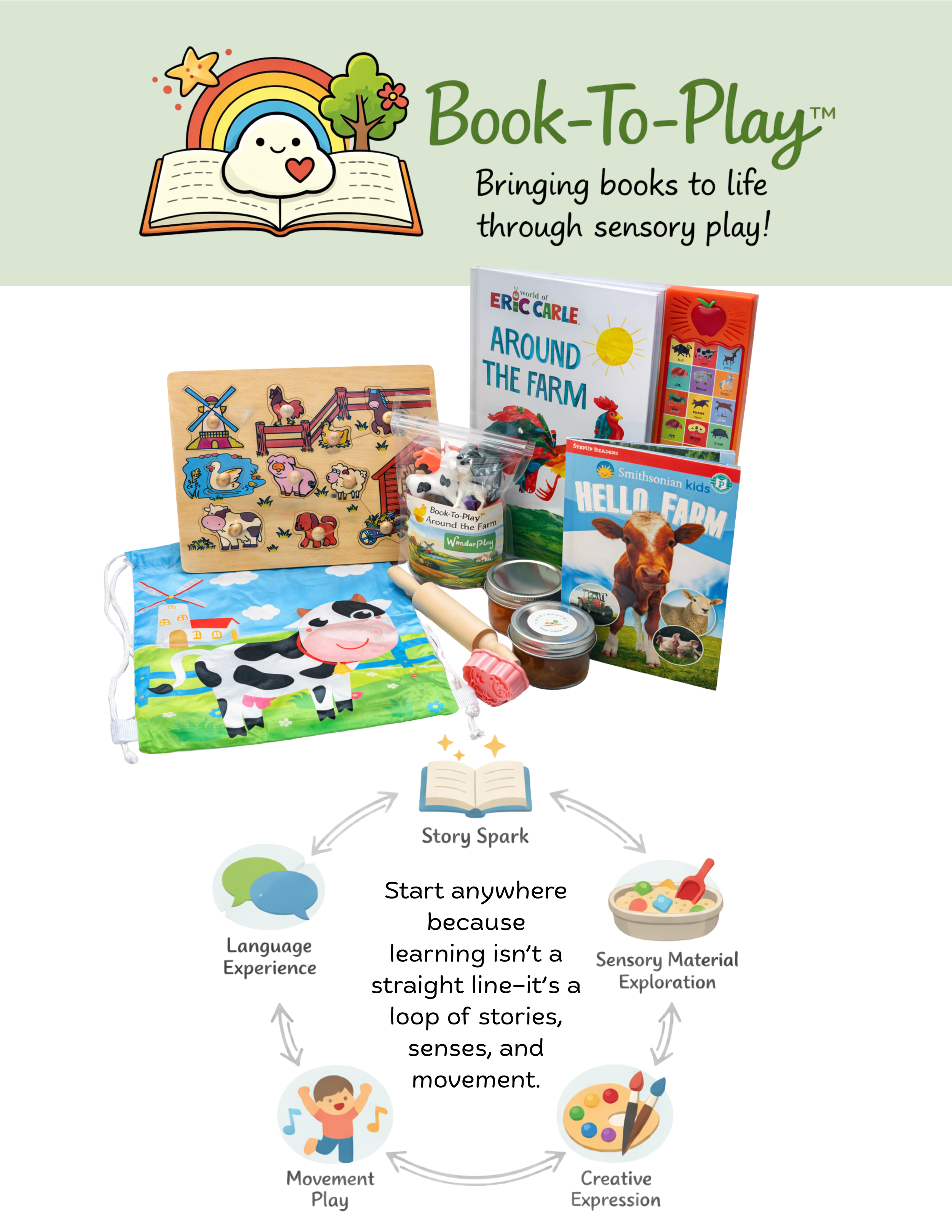
Over the past few weeks, I’ve been looking closely at my Book-to-Play™ kits and asking a simple question: What are these really meant to be? The more I reflect, the clearer it becomes that they were never intended to be “just” sensory kits. They’ve always been rooted in story, connection, and foundational learning.
Seeing beyond “sensory kit”
Most sensory kits are framed as quick, themed play: a fun filler, a few small toys, and an activity for the day. Visually, my kits might sit in that same neighborhood—but the heart of the work lives somewhere else. Each Book-to-Play™ kit is built around a thoughtfully chosen picture book and an invitation to explore that story through open-ended, sensory-rich play, with simple grown-up supports woven in.
Inside, you’ll find more than materials. There are quality texts, reusable sensory bases, curated loose parts, and educator-created guides designed to support language, story comprehension, regulation, and early academic foundations over time. In that sense, these belong with book-based learning boxes and enrichment tools, not novelty bins meant for a single afternoon.
Naming what they truly are
Because I originally led with the language of “sensory play kits,” it’s easy for people to mentally group my work with low-cost filler bins. That label doesn’t fully capture the bookish, whole-child, open-ended learning experience I’m actually offering. So I’m intentionally shifting the words I use to match the depth that’s already there.
You’ll start to see phrases like:
Book-to-Play™ Bookish Play Learning Kits
Book-to-Play™ Sensory Learning Boxes
Bookish Play Open-Ended Learning Kits
In this new framing, sensory is still essential, but it becomes the how, not the headline. The primary promise is story-rich, educator-designed learning; sensory play is the pathway children use to explore and revisit that learning.
Aligning the offer with the mission
My mission has always been to help children learn through wonder—through stories that invite questions, sensory experiences that support regulation, and play that honors their pace and process. Reframing my kits as bookish, open-ended learning experiences allows me to name that mission more clearly and show the true value of what’s inside.
In practical terms, that means:
Product titles that lead with “Book-to-Play™ Bookish Play Kit” and highlight the story connection.
Descriptions that focus first on outcomes—language, comprehension, social-emotional skills, and school readiness—before listing materials.
In-person signage that explains each kit as “one picture book + hands-on story play + an educator guide,” so the learning lens is visible at a glance.
An open-ended learning box experience
At its core, each kit is an open-ended learning box experience: a way to turn a single picture book into many moments of story-rich, sensory play and connection. Children can circle back to favorite stories, revisit skills, and discover new layers of play each time they open the box.
Whether you’re a parent, educator, therapist, or grandparent, my hope is that these Book-to-Play™ kits feel less like “a toy” and more like a companion—supporting you in creating meaningful, playful learning moments without needing to start from scratch every time.
