
WonderJars — DIY Book‑To‑Play™ Sensory Bins To‑Go (Ages 3+)
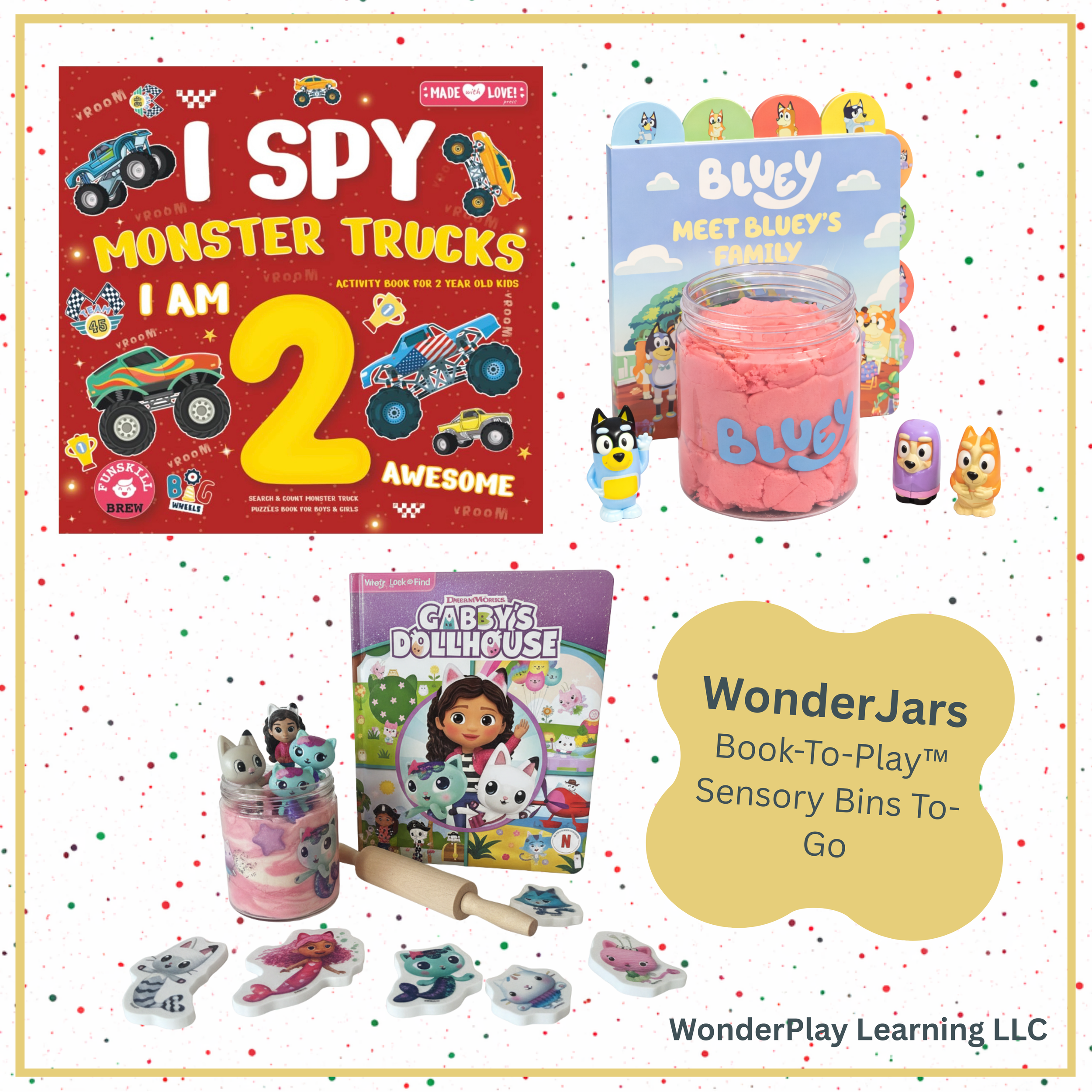
These mini sensory experiences, paired with a favorite book, have helped my non‑nappers rest more calmly, given me an easy first/then option for kids who struggle with transitions, and offered a soothing choice when little bodies feel overwhelmed.
What Is a WonderJar?
A WonderJar is a small, portable Book‑To‑Play™ Sensory Bin To‑Go.
Each WonderJar combines:
A simple sensory base (homemade play dough, rice, beans, or kinetic‑style sand).
A handful of tiny figures or toys built around your child’s current obsession.
A related book so children can “read it, build it, and play it” in one easy flow.
Instead of a big, messy bin, WonderJars are compact, contained, and travel‑friendly. You can toss one in your bag for appointments, leave one by the couch for quiet time, or keep a few on a classroom shelf for calm‑down moments. Storing each set in a little bag with the jar, figures, and book together makes it extra easy to grab‑and‑go.
Why WonderJars Work for Ages 3+
For preschoolers, stories + sensory play is a powerful combination. When you offer a WonderJar, you’re not just keeping little hands busy—you’re building skills:
Self‑regulation: Squeezing dough, burying and finding tiny objects, and driving cars slowly through sand all give the nervous system something soothing and predictable to do.
Language and literacy: Matching figures to characters, retelling parts of the story, and using words from the book in play help children deepen comprehension and vocabulary.
Imagination and problem‑solving: Children experiment with “What if…?” as they change endings, add new characters, or create completely new adventures based on the book.
And for adults, WonderJars are realistic. They don’t take over your table or require a full room reset. They’re a quick, doable way to say “yes” to sensory play and book‑based learning—even on a busy weekday.
The Basic DIY WonderJar Recipe
You don’t need special materials to make these work. Start with what you have and what your child loves.
Step 1: Choose a Theme Your Child Is Obsessed With
Think about what your child talks about nonstop right now:
Monster trucks
Bluey
Gabby’s Dollhouse
Dinosaurs
Farm animals
Superheroes
Princesses or mermaids
Pick one theme for each WonderJar. That makes it easier for your child to connect the story and the play.
Step 2: Gather a Few Mini Figures
You’re looking for tiny toys that fit inside a small jar or lidded container. Check:
Dollar stores (action figures, cars, small animals, simple people figures).
Walmart or Target (tubes of mini animals, mini cars, mystery‑pack figures, party favors).
Your own toy bins (anything that matches your theme and can be wiped clean).
Aim for 3–6 figures—enough to invite play, but not so many that the jar overflows.
Step 3: Add a Simple Sensory Base
Keep it low‑cost and low‑mess:
Homemade play dough (flour, salt, water, oil, food coloring).
Store‑bought play dough or therapy putty.
Dry rice or beans.
Kinetic‑style sand in a small amount.
The goal is a base that lets your child bury, press, stand, drive, and arrange the figures.
Step 4: Pair It With a Book
Now choose a book that fits your theme. You can use:
Favorite books you already own.
Library books you rotate in and out.
Simple activity or “look and find” books.
Place the book and the WonderJar together on a tray or in a small bag. That pairing is what makes it Book‑To‑Play™.
Step 5: Invite “Read It, Build It, Play It”
When you introduce the WonderJar, keep the invitation simple:
Read (or browse) the book together.
Say something like: “Let’s build part of the story in your WonderJar.”
Step back and let your child explore, joining in with language or questions when it feels right.
Use the same invitation during tricky moments: “First a story and your WonderJar, then we’ll head to the car,” or “You can choose your WonderJar as a calm‑down choice.”
Real‑Life WonderJar Examples
Here are three WonderJars I’ve used successfully with my own learners. Use them as inspiration, not rigid recipes.
1. Monster Truck WonderJar
You’ll need:
Mini monster truck or car figures (dollar store, Walmart, or Target party favor aisle).
A small amount of kinetic‑style sand in a jar or lidded container.
Wood blocks, craft sticks, or small pieces of scrap wood for ramps and jumps.
A monster‑truck or vehicle‑themed book—an “I Spy” style monster truck book, a simple truck picture book, or a library title about things that go.
How to use it:
Look through the book together, hunting for colors, numbers, or certain trucks.
Invite your child to “build a stunt course” or recreate a page from the book inside the jar.
Add simple prompts: “Can you make the red truck from the book?” or “Where will the trucks sleep when the race is over?”
This WonderJar has been a favorite during rest time for non‑nappers—eyes on the book, hands busy building ramps and tracks.
2. Bluey WonderJar
You’ll need:
A few small, sturdy dog figures or official Bluey minis.
Pink or blue play dough (homemade or store‑bought).
A board book or picture book featuring Bluey or another family‑based dog story (for example, Meet Bluey’s Family: A Tabbed Board Book).
How to use it:
Read the book, pausing on pages where the family is doing something familiar (playing, eating, going to the park).
Invite your child to make the setting in the dough: “Can you build Bluey’s yard?” “Where is the playground?”
Encourage simple retells: “Show me what happened first in the story using your figures.”
This WonderJar works beautifully as a calm‑down choice when kids feel overstimulated—there’s something reassuring about playing out familiar family scenes in a small, contained space.
3. Dollhouse / Cat Friends WonderJar
You’ll need:
Small dollhouse‑style figures, cats, or character minis (Gabby’s Dollhouse‑style or similar).
Swirled or glittery play dough to mimic a magical world.
A “look and find” or simple storybook that matches the dollhouse/cat theme (for example, a first Look‑and‑Find Gabby’s Dollhouse book).
How to use it:
Browse the “look and find” pages together, spotting characters and objects.
Invite your child to create different “rooms” in the dough and move characters in and out.
Add language prompts like, “Who lives in this room?” “What are they doing?” “Can you act out this page in your WonderJar?”
This WonderJar is especially helpful on first/then boards: “First your dollhouse WonderJar and book, then it’s time to clean up and go outside.”
Where WonderJars Fit Into Your Day
You can tuck WonderJars into almost any routine:
Rest time for non‑nappers.
Morning baskets or quiet start to the day.
After‑school decompression.
Calm‑down corner options.
Waiting rooms, travel, and long car rides.
The key is to keep them special and contained. Bring them out with intention, pair them with a book, and let your child know exactly when they’re available. When you’re done, pop the book, jar, and figures back into their little bag so everything is ready for next time.
Buy 2 for $25 (COMING SOON) or DIY Your Own
If you love the idea but don’t have the time or energy to gather supplies, COMING SOON you’ll be able to purchase ready‑made WonderJars—Book‑To‑Play™ Sensory Bins To‑Go, curated for ages 3+. Each one will include a sensory base, high‑interest figures, and a connected book experience, all designed through the WonderPlay Learning lens. You’ll be able to grab them in a budget‑friendly bundle: 2 for $25.
Each ready‑made WonderJar will come ready to pop into a little bag so you can keep the book, jar, and figures together and toss the whole set into your tote, car, or calm‑down corner basket.
If you’re a DIY‑er or working within a tight budget, start with one homemade WonderJar using pieces from your home, a dollar store, Walmart, or Target, and a favorite library book. Once you see how your child responds, you can slowly build a small collection of themes they love.
Try It and Share
I’d love to see how WonderJars show up in your home or classroom.
Try making one simple jar this week—maybe a monster truck, Bluey, or dollhouse theme—and pair it with a book you already own. Snap a photo of your child’s “Read it. Build it. Play it.” setup and tag @wonderplaylearning so I can cheer you on and share more ideas.
Little jars, big regulation, and story‑rich play—this is the heart of Book‑To‑Play™.
