
When “Wild” Kids Just Need a Better Environment
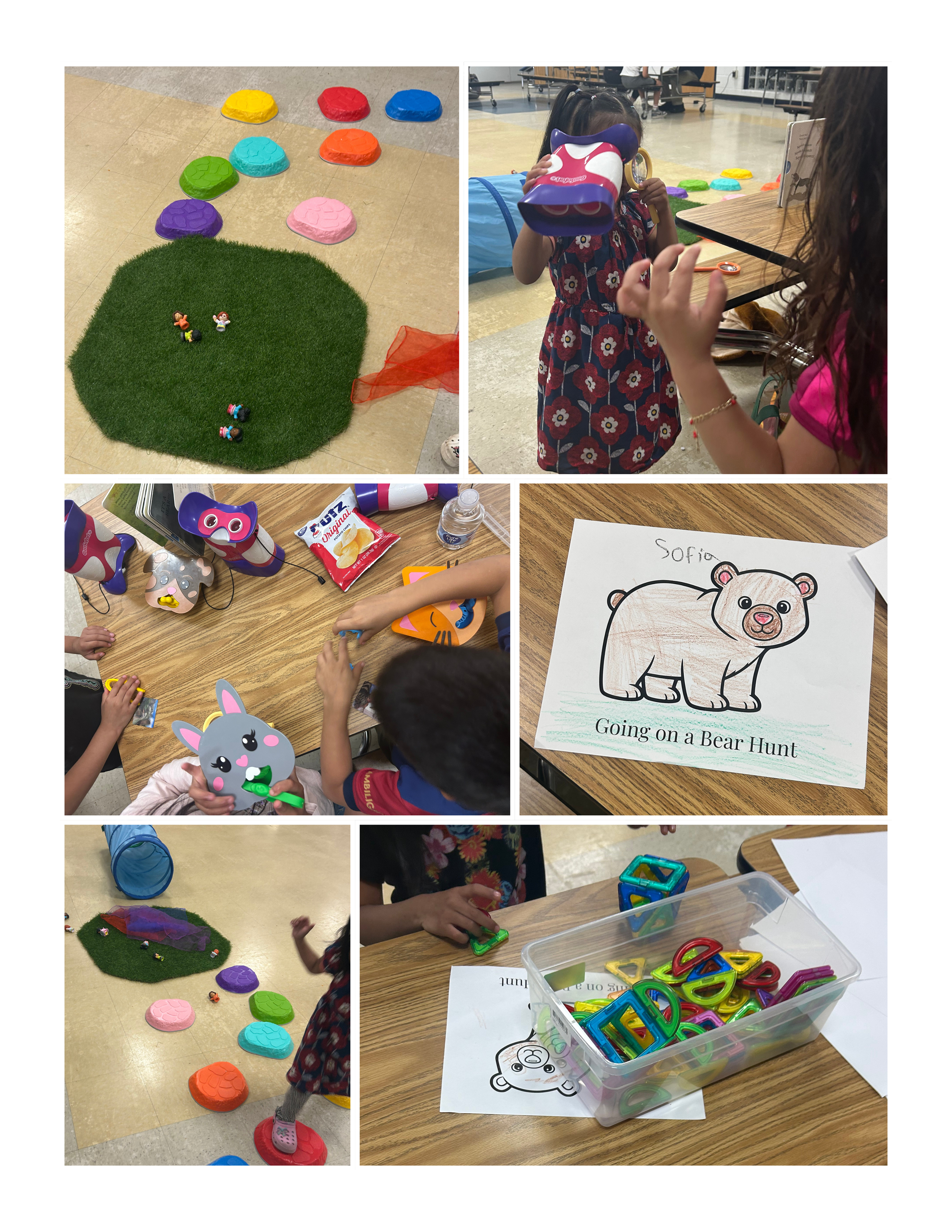
When children seem “wild” or out of control, our instinct is often to limit movement and add more structure. But what if the behavior isn’t the problem? This reflection from a real moment in a crowded school cafeteria shows how a simple shift in environment—adding purposeful movement and intentional play—can transform chaos into regulation.
Have you ever fallen into the trap of thinking that when kids are “wild” or “out of control,” what they really need is less movement… and more seat work?
That almost happened to me tonight.
I was volunteering at a pre-K registration event at a local elementary school. The cafeteria was full of young children waiting while families completed paperwork—and it felt exactly like you’d expect. Kids were running, wandering, climbing, bouncing from one thing to the next. The energy felt chaotic, and the adults were doing their best to manage it.
My first instinct surprised me.
I went out to my car to grab materials, and I intentionally avoided anything that might “add to the chaos.” No movement equipment. No big, active materials. I thought, they’re already all over the place… they don’t need more stimulation.
But as more children arrived, I paused and reconsidered.
What if the problem wasn’t too much movement…
…but not enough purposeful movement?
So I went back out to my car and brought in the very things I had initially avoided:
stepping stones, a tunnel, a small grass area, simple props for exploration, and a few quiet table invitations.
I didn’t run a structured activity.
I didn’t give a lot of directions.
I simply created zones.
And everything shifted.
The room didn’t become silent. The children didn’t suddenly sit still. They were still busy—because they are little children.
But they became regulated.
Instead of running aimlessly, they moved with intention.
Instead of bouncing from place to place, they repeated, explored, and settled into play.
Instead of chaos, there was flow.
One staff member looked at me and said,
“This is the calmest they’ve ever been.”
And the truth is—nothing I brought was extraordinary.
The difference was the environment.
So often, when children appear “out of control,” we respond by trying to reduce movement, limit options, or increase structure in ways that don’t match their developmental needs.
But young children don’t need less movement.
They need movement with meaning.
They need spaces that invite:
climbing, balancing, crawling, carrying, exploring, imagining, repeating.
They need environments that help their bodies organize—not shut down.
Tonight was a powerful reminder for me:
Children aren’t the problem.
The environment is often just not designed for them yet.
And when we shift the environment—even in small, simple ways—we give children the opportunity to show us what they are truly capable of.
From Simple to Immersive: Choosing the Right Book-To-Play™ Experience
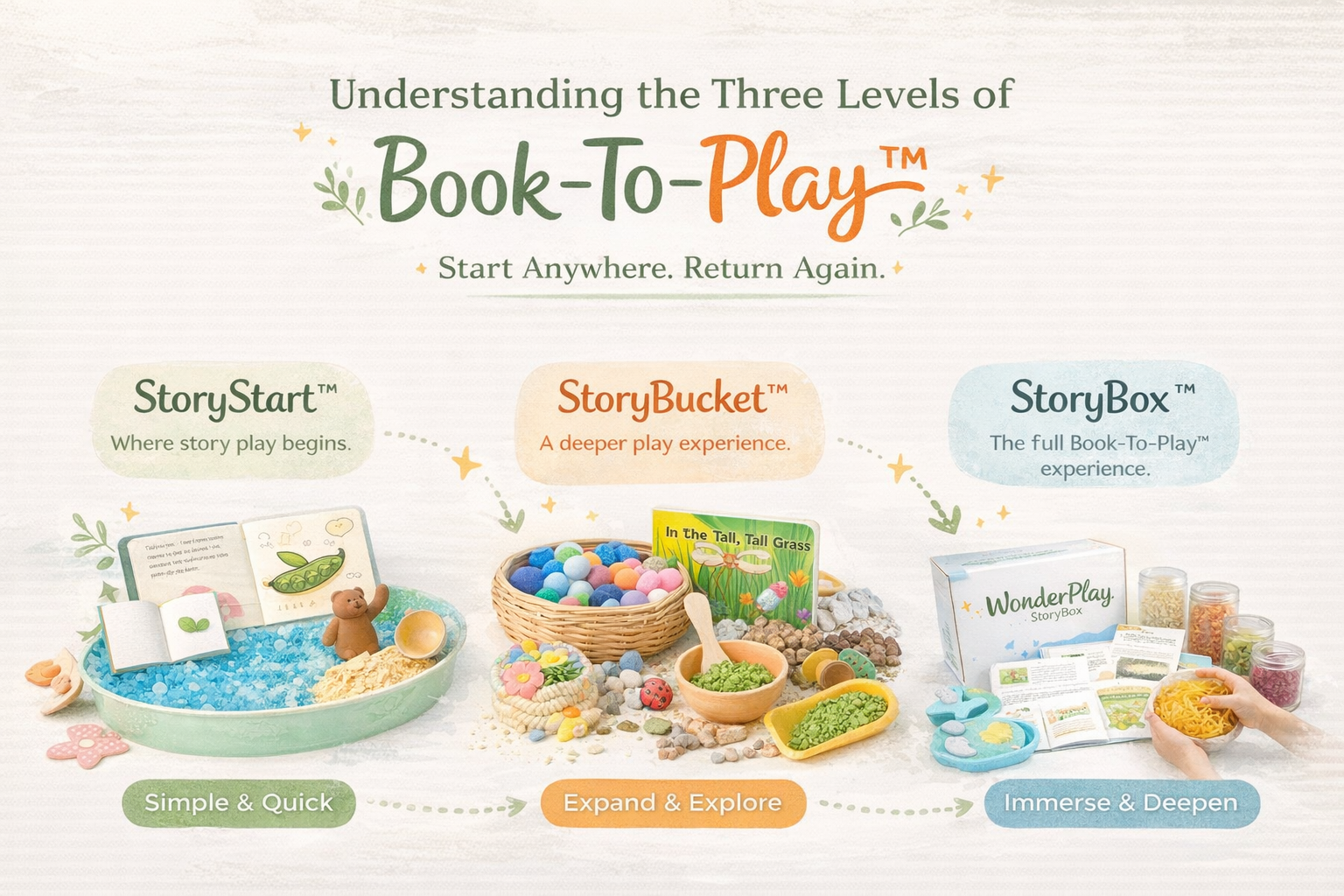
Understanding the Three Levels of Book-To-Play™ Experiences
When we think about learning for young children, it’s easy to feel like we need to do more.
More activities.
More structure.
More “teaching.”
But what if learning didn’t need more?
What if it needed something different?
At WonderPlay, our Book-To-Play™ approach is designed around a simple idea:
Children learn best through play, movement, and connection—when experiences are meaningful and can be returned to again and again.
That’s why our products are designed in three thoughtful tiers, each offering a different level of depth—while still honoring the same core philosophy.
Because learning isn’t linear.
And neither is play.
The Book-To-Play™ Philosophy
Before diving into the tiers, it’s important to understand the foundation.
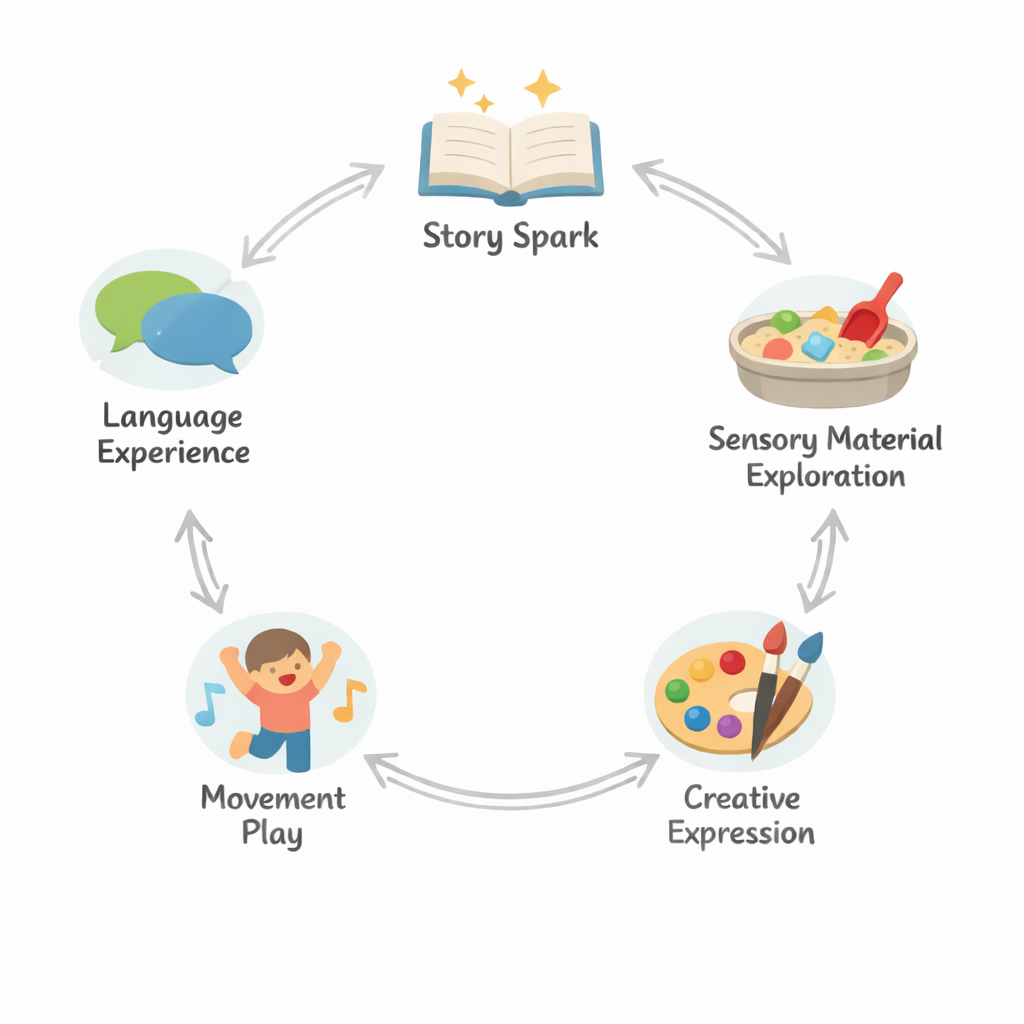
Every WonderPlay experience follows a flexible, repeatable cycle:
Story → Play → Create → Move → Connect
Children can enter anywhere.
They can revisit, repeat, and explore in new ways each time.
There’s no “right” order.
No pressure to complete.
Just space for learning to unfold.
StoryStart™
Where story play begins
StoryStart™ is your entry point into Book-To-Play™.
Simple. Intentional. Ready to use.
Each StoryStart™ offers just enough to spark curiosity and invite children into play—without overwhelm.
It’s designed for those everyday moments when you want something meaningful, but manageable.
You might open a StoryStart™ and:
read a familiar rhyme or story
explore a small sensory invitation
notice what your child is drawn to
and follow their lead
It’s not about doing everything.
It’s about beginning.
Perfect for:
trying Book-To-Play™ for the first time
quick, meaningful play moments
building routines around story and play
StoryBucket™
A deeper play experience
StoryBucket™ expands the experience.
More materials.
More possibilities.
More ways to explore and return.
This is where play begins to stretch.
Children might:
revisit the same story in new ways
explore different sensory elements
begin to create, sort, imagine, and move
make connections across experiences
With StoryBucket™, the goal isn’t to move on quickly.
It’s to stay longer.
To revisit.
To deepen.
To let play evolve.
Perfect for:
children who want to explore longer
families or classrooms building play routines
open-ended, repeated use over time
StoryBox™
The full Book-To-Play™ experience
StoryBox™ is the most complete expression of Book-To-Play™.
A fully immersive, thoughtfully curated experience designed to support deeper learning over time.
Inside a StoryBox™, you’ll find:
book-based connections
sensory materials
movement invitations
language supports
guided ideas for extending play
Everything works together—but nothing is rigid.
Children can:
start anywhere
move between experiences
return again and again
Because the goal isn’t completion.
It’s connection.
Understanding.
Growth.
Perfect for:
families who want a full, guided experience
classrooms and therapy settings
extended, meaningful engagement over days or weeks
Which One Should You Choose?
There’s no “right” place to start.
Each tier meets you where you are.
StoryStart™ → begin simply
StoryBucket™ → expand and explore
StoryBox™ → immerse and deepen
And just like children, you don’t have to move in a straight line.
You can start small.
You can go deeper.
You can return again.
A Different Way to Think About Play
At WonderPlay, we don’t rush development.
We don’t over-direct play.
We create space for children to explore, connect, and grow in ways that feel natural and meaningful.
Because when children are engaged, regulated, and connected—
learning doesn’t have to be forced.
It unfolds.
Ready to begin your Book-To-Play™ journey?
From Sensory Kit to Bookish Play: Evolving the Book-to-Play™ Experience
Over the past few weeks, I’ve been looking closely at my Book-to-Play™ kits and asking a simple question: What are these really meant to be? The more I reflect, the clearer it becomes that they were never intended to be “just” sensory kits. They’ve always been rooted in story, connection, and foundational learning.
Seeing beyond “sensory kit”
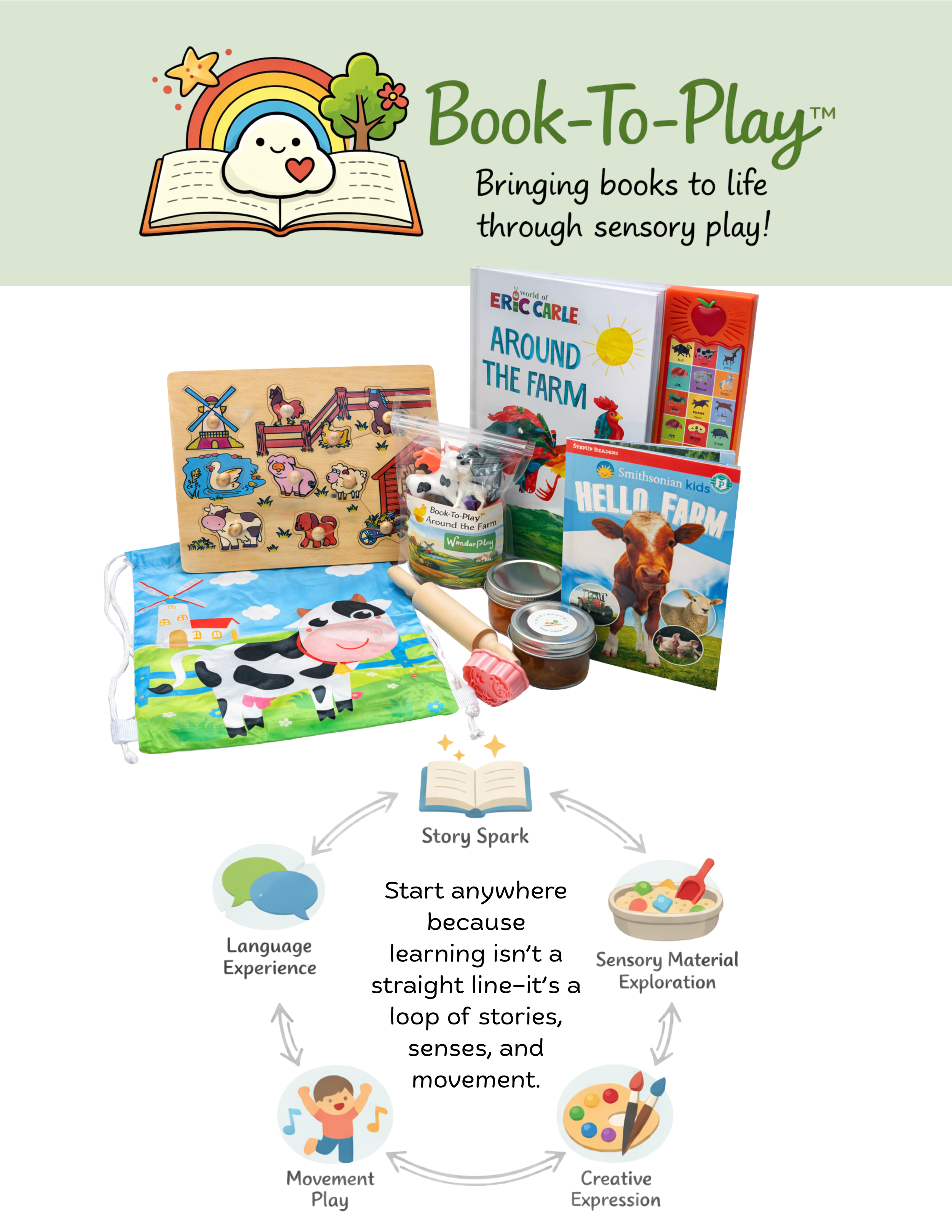
Most sensory kits are framed as quick, themed play: a fun filler, a few small toys, and an activity for the day. Visually, my kits might sit in that same neighborhood—but the heart of the work lives somewhere else. Each Book-to-Play™ kit is built around a thoughtfully chosen picture book and an invitation to explore that story through open-ended, sensory-rich play, with simple grown-up supports woven in.
Inside, you’ll find more than materials. There are quality texts, reusable sensory bases, curated loose parts, and educator-created guides designed to support language, story comprehension, regulation, and early academic foundations over time. In that sense, these belong with book-based learning boxes and enrichment tools, not novelty bins meant for a single afternoon.
Naming what they truly are
Because I originally led with the language of “sensory play kits,” it’s easy for people to mentally group my work with low-cost filler bins. That label doesn’t fully capture the bookish, whole-child, open-ended learning experience I’m actually offering. So I’m intentionally shifting the words I use to match the depth that’s already there.
You’ll start to see phrases like:
Book-to-Play™ Bookish Play Learning Kits
Book-to-Play™ Sensory Learning Boxes
Bookish Play Open-Ended Learning Kits
In this new framing, sensory is still essential, but it becomes the how, not the headline. The primary promise is story-rich, educator-designed learning; sensory play is the pathway children use to explore and revisit that learning.
Aligning the offer with the mission
My mission has always been to help children learn through wonder—through stories that invite questions, sensory experiences that support regulation, and play that honors their pace and process. Reframing my kits as bookish, open-ended learning experiences allows me to name that mission more clearly and show the true value of what’s inside.
In practical terms, that means:
Product titles that lead with “Book-to-Play™ Bookish Play Kit” and highlight the story connection.
Descriptions that focus first on outcomes—language, comprehension, social-emotional skills, and school readiness—before listing materials.
In-person signage that explains each kit as “one picture book + hands-on story play + an educator guide,” so the learning lens is visible at a glance.
An open-ended learning box experience
At its core, each kit is an open-ended learning box experience: a way to turn a single picture book into many moments of story-rich, sensory play and connection. Children can circle back to favorite stories, revisit skills, and discover new layers of play each time they open the box.
Whether you’re a parent, educator, therapist, or grandparent, my hope is that these Book-to-Play™ kits feel less like “a toy” and more like a companion—supporting you in creating meaningful, playful learning moments without needing to start from scratch every time.
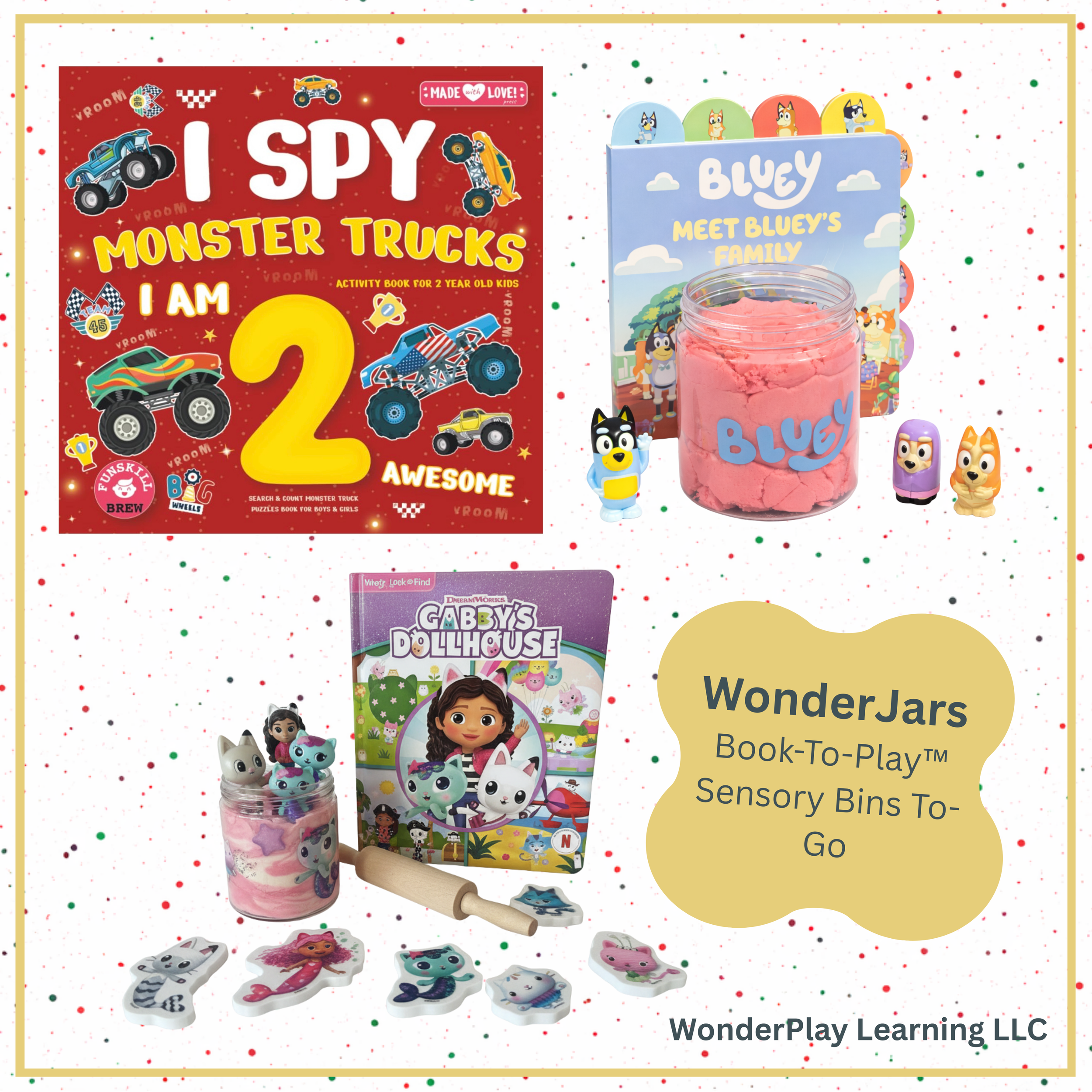
WonderJars — DIY Book‑To‑Play™ Sensory Bins To‑Go (Ages 3+)
Over the last couple of weeks, one of the most powerful ways I’ve supported my preschoolers in group care hasn’t been a fancy curriculum or a new behavior chart. It’s been tiny, interest‑based Book‑To‑Play™ set‑ups tucked into small containers—what I’m now calling WonderJars.
These mini sensory experiences, paired with a favorite book, have helped my non‑nappers rest more calmly, given me an easy first/then option for kids who struggle with transitions, and offered a soothing choice when little bodies feel overwhelmed.
What Is a WonderJar?
A WonderJar is a small, portable Book‑To‑Play™ Sensory Bin To‑Go.
Each WonderJar combines:
A simple sensory base (homemade play dough, rice, beans, or kinetic‑style sand).
A handful of tiny figures or toys built around your child’s current obsession.
A related book so children can “read it, build it, and play it” in one easy flow.
Instead of a big, messy bin, WonderJars are compact, contained, and travel‑friendly. You can toss one in your bag for appointments, leave one by the couch for quiet time, or keep a few on a classroom shelf for calm‑down moments. Storing each set in a little bag with the jar, figures, and book together makes it extra easy to grab‑and‑go.
Why WonderJars Work for Ages 3+
For preschoolers, stories + sensory play is a powerful combination. When you offer a WonderJar, you’re not just keeping little hands busy—you’re building skills:
Self‑regulation: Squeezing dough, burying and finding tiny objects, and driving cars slowly through sand all give the nervous system something soothing and predictable to do.
Language and literacy: Matching figures to characters, retelling parts of the story, and using words from the book in play help children deepen comprehension and vocabulary.
Imagination and problem‑solving: Children experiment with “What if…?” as they change endings, add new characters, or create completely new adventures based on the book.
And for adults, WonderJars are realistic. They don’t take over your table or require a full room reset. They’re a quick, doable way to say “yes” to sensory play and book‑based learning—even on a busy weekday.
The Basic DIY WonderJar Recipe
You don’t need special materials to make these work. Start with what you have and what your child loves.
Step 1: Choose a Theme Your Child Is Obsessed With
Think about what your child talks about nonstop right now:
Monster trucks
Bluey
Gabby’s Dollhouse
Dinosaurs
Farm animals
Superheroes
Princesses or mermaids
Pick one theme for each WonderJar. That makes it easier for your child to connect the story and the play.
Step 2: Gather a Few Mini Figures
You’re looking for tiny toys that fit inside a small jar or lidded container. Check:
Dollar stores (action figures, cars, small animals, simple people figures).
Walmart or Target (tubes of mini animals, mini cars, mystery‑pack figures, party favors).
Your own toy bins (anything that matches your theme and can be wiped clean).
Aim for 3–6 figures—enough to invite play, but not so many that the jar overflows.
Step 3: Add a Simple Sensory Base
Keep it low‑cost and low‑mess:
Homemade play dough (flour, salt, water, oil, food coloring).
Store‑bought play dough or therapy putty.
Dry rice or beans.
Kinetic‑style sand in a small amount.
The goal is a base that lets your child bury, press, stand, drive, and arrange the figures.
Step 4: Pair It With a Book
Now choose a book that fits your theme. You can use:
Favorite books you already own.
Library books you rotate in and out.
Simple activity or “look and find” books.
Place the book and the WonderJar together on a tray or in a small bag. That pairing is what makes it Book‑To‑Play™.
Step 5: Invite “Read It, Build It, Play It”
When you introduce the WonderJar, keep the invitation simple:
Read (or browse) the book together.
Say something like: “Let’s build part of the story in your WonderJar.”
Step back and let your child explore, joining in with language or questions when it feels right.
Use the same invitation during tricky moments: “First a story and your WonderJar, then we’ll head to the car,” or “You can choose your WonderJar as a calm‑down choice.”
Real‑Life WonderJar Examples
Here are three WonderJars I’ve used successfully with my own learners. Use them as inspiration, not rigid recipes.
1. Monster Truck WonderJar
You’ll need:
Mini monster truck or car figures (dollar store, Walmart, or Target party favor aisle).
A small amount of kinetic‑style sand in a jar or lidded container.
Wood blocks, craft sticks, or small pieces of scrap wood for ramps and jumps.
A monster‑truck or vehicle‑themed book—an “I Spy” style monster truck book, a simple truck picture book, or a library title about things that go.
How to use it:
Look through the book together, hunting for colors, numbers, or certain trucks.
Invite your child to “build a stunt course” or recreate a page from the book inside the jar.
Add simple prompts: “Can you make the red truck from the book?” or “Where will the trucks sleep when the race is over?”
This WonderJar has been a favorite during rest time for non‑nappers—eyes on the book, hands busy building ramps and tracks.
2. Bluey WonderJar
You’ll need:
A few small, sturdy dog figures or official Bluey minis.
Pink or blue play dough (homemade or store‑bought).
A board book or picture book featuring Bluey or another family‑based dog story (for example, Meet Bluey’s Family: A Tabbed Board Book).
How to use it:
Read the book, pausing on pages where the family is doing something familiar (playing, eating, going to the park).
Invite your child to make the setting in the dough: “Can you build Bluey’s yard?” “Where is the playground?”
Encourage simple retells: “Show me what happened first in the story using your figures.”
This WonderJar works beautifully as a calm‑down choice when kids feel overstimulated—there’s something reassuring about playing out familiar family scenes in a small, contained space.
3. Dollhouse / Cat Friends WonderJar
You’ll need:
Small dollhouse‑style figures, cats, or character minis (Gabby’s Dollhouse‑style or similar).
Swirled or glittery play dough to mimic a magical world.
A “look and find” or simple storybook that matches the dollhouse/cat theme (for example, a first Look‑and‑Find Gabby’s Dollhouse book).
How to use it:
Browse the “look and find” pages together, spotting characters and objects.
Invite your child to create different “rooms” in the dough and move characters in and out.
Add language prompts like, “Who lives in this room?” “What are they doing?” “Can you act out this page in your WonderJar?”
This WonderJar is especially helpful on first/then boards: “First your dollhouse WonderJar and book, then it’s time to clean up and go outside.”
Where WonderJars Fit Into Your Day
You can tuck WonderJars into almost any routine:
Rest time for non‑nappers.
Morning baskets or quiet start to the day.
After‑school decompression.
Calm‑down corner options.
Waiting rooms, travel, and long car rides.
The key is to keep them special and contained. Bring them out with intention, pair them with a book, and let your child know exactly when they’re available. When you’re done, pop the book, jar, and figures back into their little bag so everything is ready for next time.
Buy 2 for $25 (COMING SOON) or DIY Your Own
If you love the idea but don’t have the time or energy to gather supplies, COMING SOON you’ll be able to purchase ready‑made WonderJars—Book‑To‑Play™ Sensory Bins To‑Go, curated for ages 3+. Each one will include a sensory base, high‑interest figures, and a connected book experience, all designed through the WonderPlay Learning lens. You’ll be able to grab them in a budget‑friendly bundle: 2 for $25.
Each ready‑made WonderJar will come ready to pop into a little bag so you can keep the book, jar, and figures together and toss the whole set into your tote, car, or calm‑down corner basket.
If you’re a DIY‑er or working within a tight budget, start with one homemade WonderJar using pieces from your home, a dollar store, Walmart, or Target, and a favorite library book. Once you see how your child responds, you can slowly build a small collection of themes they love.
Try It and Share
I’d love to see how WonderJars show up in your home or classroom.
Try making one simple jar this week—maybe a monster truck, Bluey, or dollhouse theme—and pair it with a book you already own. Snap a photo of your child’s “Read it. Build it. Play it.” setup and tag @wonderplaylearning so I can cheer you on and share more ideas.
Little jars, big regulation, and story‑rich play—this is the heart of Book‑To‑Play™.
The Play Continuum: How Children Build Brains Through Play
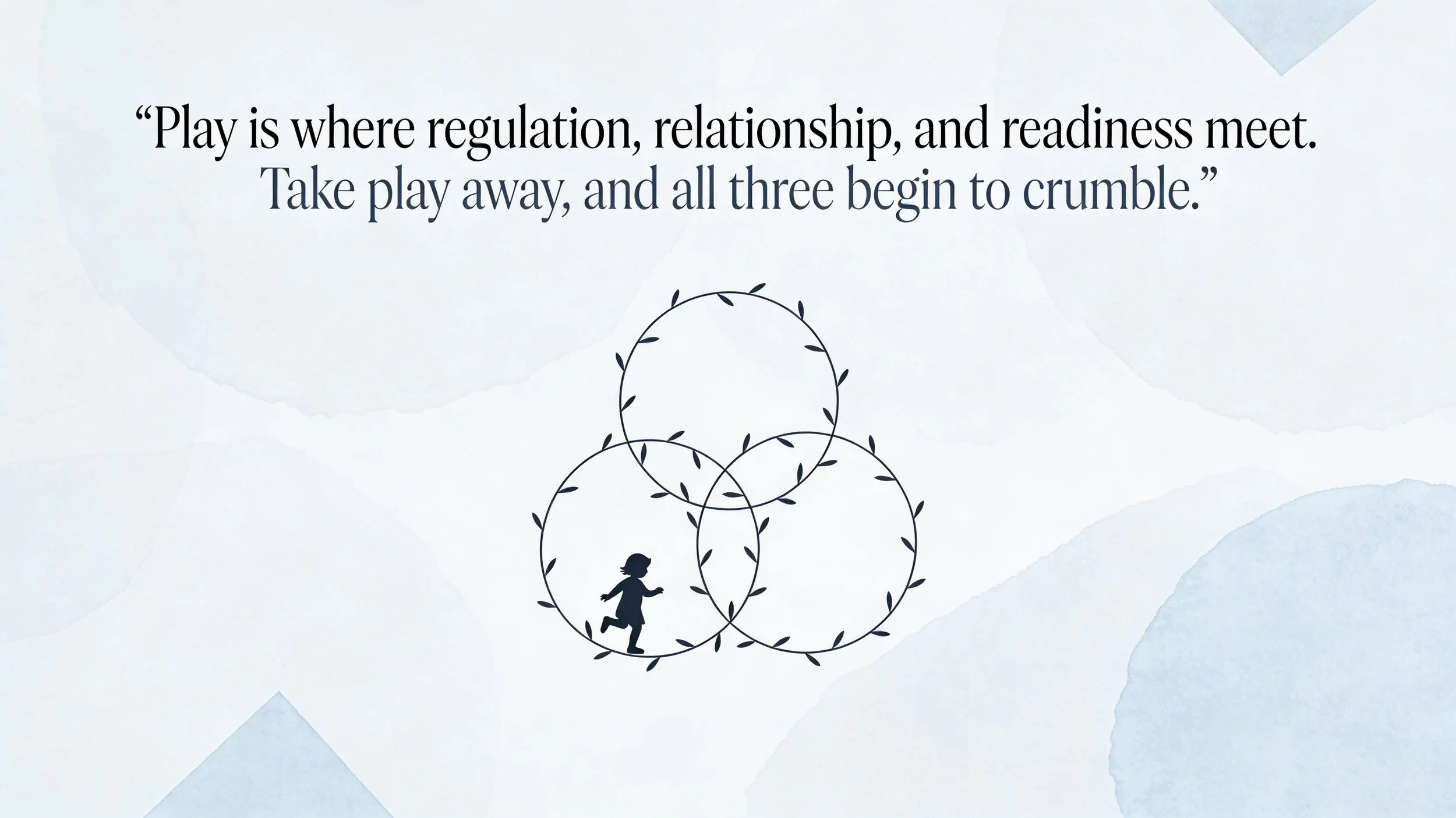
Play isn’t what happens after the “real learning” is done—play is how young children build the brain systems school depends on: attention, self‑regulation, problem‑solving, and language.
Play isn’t what happens after the “real learning” is done.
It is the real learning.
Play is one of the main ways young children build the brain systems that make school possible—attention, self‑regulation, problem‑solving, and language.
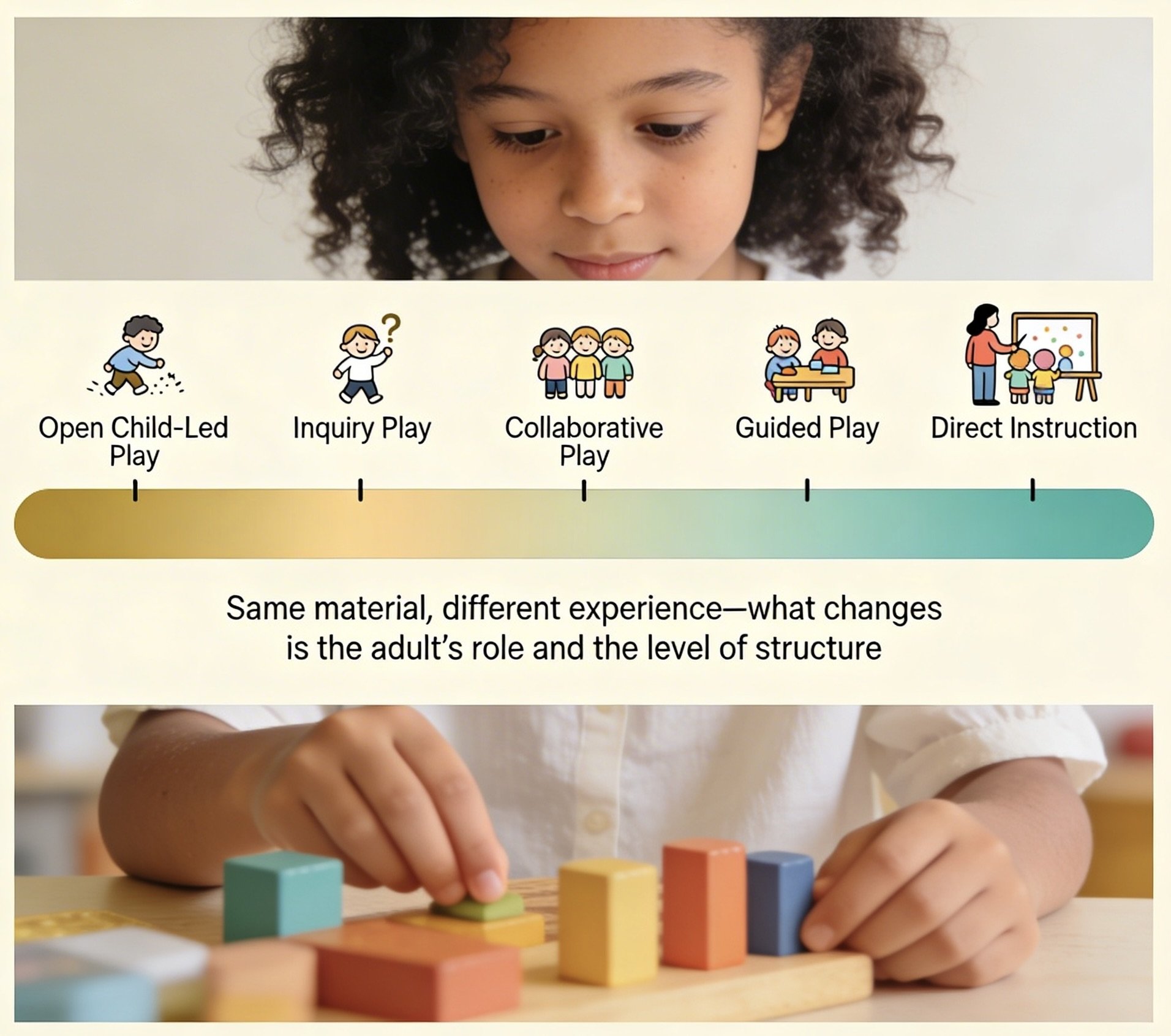
One powerful way to see this in action is through the play continuum—and you can explore that continuum clearly using just one simple material: a syllable picture card.
What Is the Play Continuum?
Instead of thinking “play vs. work,” imagine a spectrum.
On one end is open, child-led play: children decide what to do, how to do it, and how long to stay. Adults are nearby for safety, language support, and connection.
On the other end is direct instruction: the adult sets the goal, steps, and expectations for what counts as “right.”
In the middle is guided play or playful learning: children are still playing, but adults gently steer toward specific skills through questions, prompts, or smartly designed environments.
High-quality early learning doesn’t live at just one point on this continuum.
Children need all of these experiences across a week—but not in equal amounts, and not chopped into dozens of tiny blocks.
One Material, Many Kinds of Play
Let’s take one simple printable—a picture of an octopus syllable card with the numbers 2, 3, and 4 on the side.
Same card. Completely different experiences depending on how we use it.
1. Open Child-Led Play
The card simply becomes part of the environment.
You might place it in a basket with toy sea animals, playdough, or pretend “ocean restaurant” props.
Children decide what it becomes—a menu, a ticket, a pet, or a sign.
No one asks, “How many syllables does octopus have?” unless a child brings it up.
What’s building: Imagination, vocabulary, social skills, and flexible thinking. Children gain early comfort with images, symbols, and print—long before being asked to perform a literacy task.
2. Inquiry Play: When Children’s Questions Lead
Now a child spots the numbers:
“Why does the octopus card have a 3 on it?”
You stay curious:
“Hmm, what do you think it might mean?”
Children test ideas—number of legs, dots, or pieces of food—and you follow their thinking.
Eventually you might invite:
“Let’s try clapping oc–to–pus and see if that matches any of these numbers.”
What’s building: Problem‑solving, reasoning, curiosity, and early phonological awareness—all sparked by the child’s own wondering.
3. Collaborative Play: Creating Together
Now you and the children co-create with the cards.
“Let’s make an Ocean Word Wall together!”
Children choose cards, clap the names, and sort them into “short,” “medium,” and “long” word groups. They decorate or mark each word’s beats.
What’s building: Cooperation, early math (grouping and comparing), language, and persistence on a shared project. Children also practice negotiation and turn‑taking.
4. Guided Play: Playful Learning With a Clear Goal
Now you introduce a learning target—counting syllables—but frame it within playful storytelling.
“The ocean animals lost their beats! They need Syllable Detectives to help them hear their names.”
Children clap, tap, or jump syllables and match them to the correct number.
You ask open questions:
“How many beats did you hear?”
“Can you find another with the same number?”
“What happens if we say it slowly? Does the number change?”
What’s building: Phonological awareness plus executive function—attention, memory, and flexible strategy use—all in a joyful play frame.
5. Direct Instruction: Structured, But Still Playful
At the far end of the continuum is direct teaching.
You explain:
“Syllables are the beats in a word. Watch: oc–to–pus.”
Children clap along, count, and match the number. Small-group centers might include cards and an “I can” card (“I can clap the beats and clip the number”).
What’s building: Accuracy, confidence, and comfort following routines—important foundations for school life.
Why Balance Matters for School Readiness
Real school readiness is so much more than reciting letters or counting to 20.
Children need:
Strong executive function—focus, flexibility, and impulse control
Solid self‑regulation—managing big feelings and bouncing back from frustration
Deep oral language and vocabulary
Curiosity, persistence, and problem-solving confidence
These systems grow in the slow, stretchy parts of the day: long blocks of play where children can explore, return, and revise.
When every few minutes are filled with new activities—“Now it’s syllables, now it’s shapes, now it’s counting”—children spend more energy adjusting than learning. Their nervous systems stay on alert, and adults spend more time managing behavior than deepening engagement.
But when we protect long stretches of play, and weave gentle guidance and short bursts of instruction within them, magic happens:
Brains wire new connections through repetition and engagement.
Regulation improves because children complete the full play cycle.
Adults can observe and scaffold with precision, not pressure.
What a Healthy Daily Balance Looks Like
For most preschoolers (ages 3–5), a brain-friendly day includes:
Long blocks of open and guided play—indoors and outdoors
Open-ended materials: blocks, sensory bins, art, dramatic play
Adults as play partners—modeling language, adding subtle challenges
Short, focused teaching moments—mini-lessons or small-group skill work
Few transitions—smooth, predictable, and paced with the child in mind
Opportunities for movement and sensory regulation before extended seated time
This balance honors both sides of the coin:
Children’s need for deep, joyful play that builds brain architecture
Adults’ responsibility to ensure access to key academic skills
How Families and Educators Can Use This
When you introduce a syllable card (or any learning material):
Start with open play—let children make it their own.
Move into inquiry or collaborative play when curiosity sparks.
Use guided play to highlight specific learning goals.
Wrap up with direct instruction when targeted practice is ready.
You don’t have to choose between play and learning.
The real question is:
“Where on the play continuum is this activity right now—and what does this child need today?”
When we honor the full play continuum, we’re not losing learning time.
We’re giving children exactly what they need to build strong brains, calm nervous systems, and a deep, enduring readiness for both school and life.
Sensory play is the foundation (not a bonus)
Sensory play isn’t “extra”—it’s a high-impact way young children build the skills we often try to teach later with worksheets: language, early math, self-regulation, problem-solving, and the hand strength/coordination that supports writing. NAEYC describes play as a central teaching practice and notes consistent links between play and foundational capacities like self-regulation, working memory, oral language, and school success.
When children are up to their elbows in dough, scooping pasta, and inventing dinosaur stories, they’re doing real learning—active, meaningful, and driven by their own choices. NAEYC emphasizes that daily, sustained play supports children’s language, peer relationships, physical development (including fine-motor), and problem-solving.
And importantly: play isn’t the opposite of learning—it’s often the vehicle for it. NAEYC also cautions educators not to reduce or eliminate play (even for children who need extra support), because play builds self-regulatory, linguistic, cognitive, and social benefits.
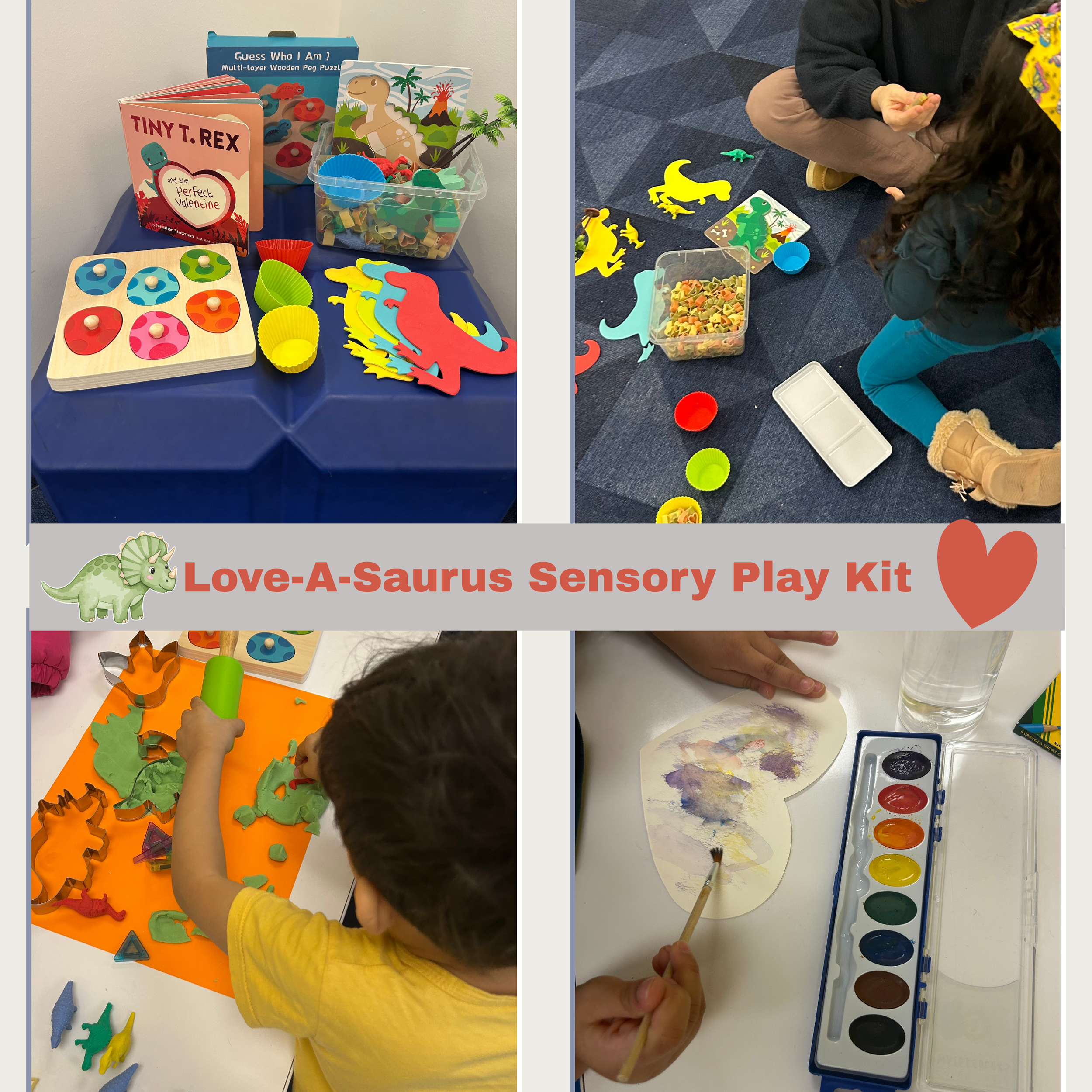
A “Love-a-Saurus” setup, 60 minutes of learning
Today’s invitation was simple: playdough, pasta, and a few dinosaur shapes—set up fast, prepped with intention, and then you let the children take it from there. NAEYC explains that play helps children explore and make sense of their world, interact with others, express and control emotions, and practice emerging skills—all of which you saw unfolding in real time.
Here’s what was happening beneath the surface:
Playdough became dino “snacks” and “heart” necklaces: symbolic thinking and storytelling—play is linked with imagination, language, and problem-solving.
Pasta was sorted, counted, scooped, compared: early math concepts embedded in meaningful activity, not isolated drills.
Children persisted, collaborated, and adapted plans: play is associated with foundational capacities like self-regulation and working memory that support success in school.
Why hands-on play grows brains
When children squeeze, roll, pinch, press, and create, they aren’t just “keeping busy”—they’re building the coordination and control that later shows up in classroom tasks. NAEYC explicitly notes that play supports physical development including fine-motor competence, alongside language and cognitive growth.
Sensory-rich, child-led experiences also invite sustained attention because the child is invested—there’s a reason engagement lasts longer than it does with flashcards. NAEYC’s description of play highlights choice, wonder, and delight as drivers of continued engagement, exploration, and meaning-making.
Executive function grows in playful moments
Executive function skills (planning, focusing attention, shifting, managing impulses) are often described as the brain’s “air traffic control system.” Harvard’s Center on the Developing Child uses that exact metaphor and explains that these skills help us plan, focus, switch gears, and juggle tasks—skills children build through supportive experiences across the places they live and learn.
Play is one of the most natural contexts for practicing those skills: children set goals (“Let’s make snacks for the baby dino”), hold rules in mind (“This is the necklace station”), shift strategies when something doesn’t work, and negotiate roles with peers. NAEYC also connects play with foundational capacities such as self-regulation and working memory—both central pieces of executive function.
Try it tomorrow (simple setup, profound impact)
If you want to recreate a Love-a-Saurus-style sensory invitation, keep it intentionally minimal:
Base: Playdough (or homemade salt dough).
Loose parts: Pasta, buttons, gems, pebbles (large enough to be safe for your age group).
Tools: Dino cutters, rollers, tongs, cups, scoops.
Simple Dino puzzles
Teacher move: Observe, narrate, and extend with open questions (“What happens if…?”, “How could we sort these?”, “Tell me about your dinosaur family?”).
Beyond the Alphabet: Building a Kindergarten-Ready Kiddo 🧠🏃♀️
When people talk about kindergarten readiness, it often sounds like a shopping list of academic tricks: know your letters, count to 20, recognize shapes, write your name. But real readiness is much bigger and far more joyful. It’s not a checklist. It’s a whole-child state of development shaped by how a child thinks, moves, regulates, and connects with others.
When people talk about kindergarten readiness, it often sounds like a shopping list of academic tricks: know your letters, count to 20, recognize shapes, write your name. But real readiness is much bigger and far more joyful. It’s not a checklist. It’s a whole-child state of development shaped by how a child thinks, moves, regulates, and connects with others.
Kindergarten readiness grows slowly and beautifully across the entire birth-to-five journey, especially through play, movement, and rich sensory experiences. A few months of “academic prep” can’t replace the foundation built through years of climbing, pretending, puzzling, and practicing independence.
Beyond Memorizing Facts
Many adults still equate readiness with early academics. If a child can recite the alphabet, count objects, or name shapes on command, we assume they’re ready. But learning research tells a different story. Rote memorization supports short-term performance, not deep understanding, flexible thinking, or long-term learning.
When early childhood is filled with drills and worksheets, something important gets crowded out: play. And play is where problem-solving, curiosity, creativity, and critical thinking are born. These skills, not early recitation, are far more predictive of long-term school success.
If a child can “perform” but struggles to follow directions, manage frustration, wait their turn, or work with peers, the issue isn’t missing facts. The issue is missing foundations. Kindergarten readiness lives in self-regulation, social skills, and sensory development, even when those don’t show up on a flashcard.
The Ability to Think
A kindergarten-ready child doesn’t just know answers; they know how to think. That means noticing patterns, asking questions, trying ideas, and adjusting when something doesn’t work.
These thinking skills grow through open-ended play, not through being told exactly what to do. Children build them when they:
Engage in pretend play, construction, and exploration that requires planning and troubleshooting
Talk with adults and peers about what they’re doing, why it happened, and what they might try next
Have time to repeat, change, and extend activities instead of rushing from one task to the next
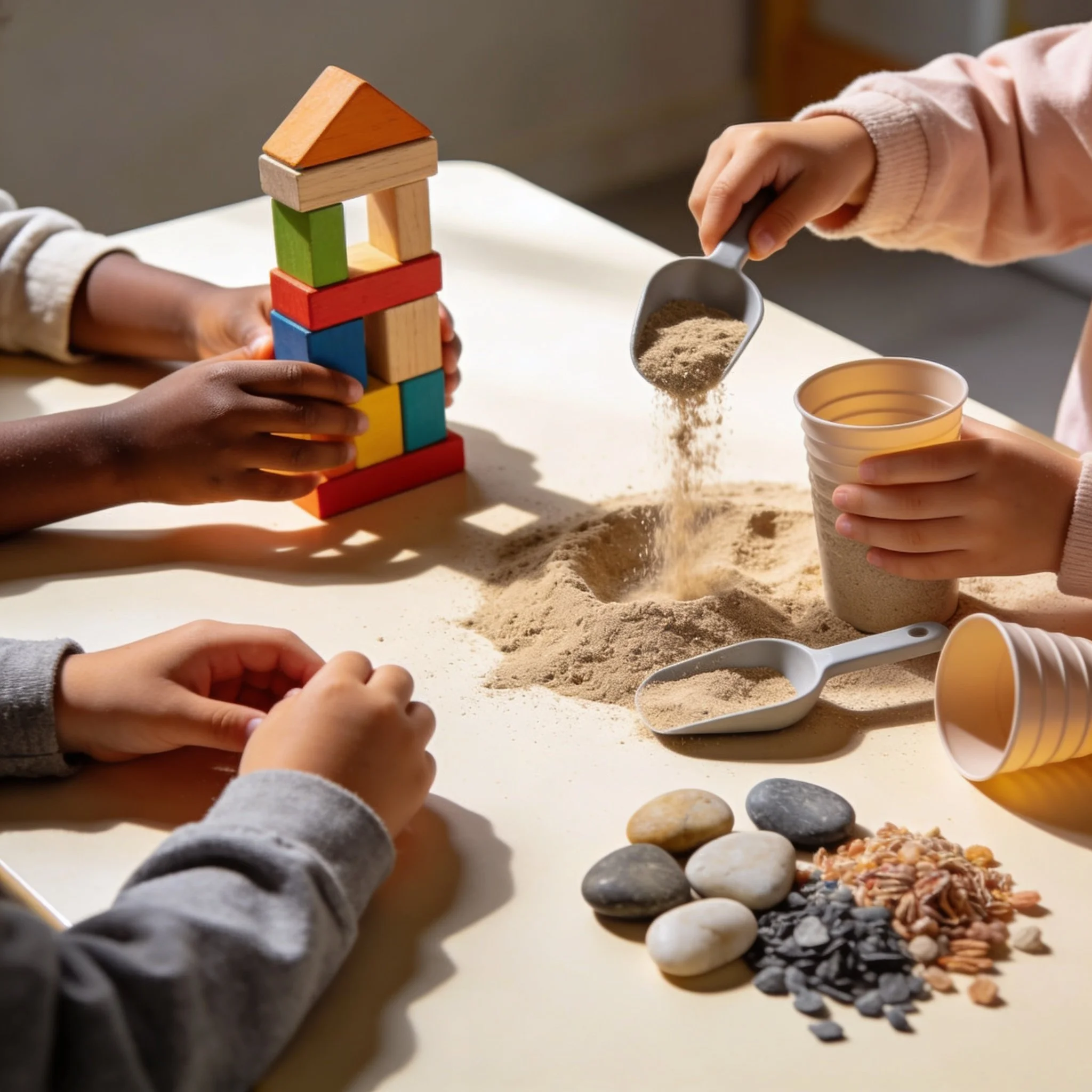
A child figuring out how to keep a block tower from falling, negotiating roles in pretend play, or experimenting with how water moves through sand is doing serious readiness work. Even if they can’t yet name every letter, their brain is learning how to learn.
The Ability to Do Things Independently
Independence is a huge part of kindergarten success. Children who can manage basic self-care and classroom routines adjust more smoothly to school and feel more confident in their abilities.
In real life, this looks like a child who can:
Use the bathroom, wash hands, open containers, and put on shoes with minimal help
Follow simple routines and stay with a task for a reasonable amount of time
Care for materials by putting items away, handling books gently, and managing their belongings
These skills don’t develop by adults doing everything for children. They grow when adults intentionally step back and allow productive struggle. When environments are set up for success and children are trusted to try, confidence follows.
The Ability to Accept Support
Being ready for kindergarten doesn’t mean doing everything alone. It also means knowing how to accept help. Children who can ask for support, follow adult cues, and calm with a trusted adult tend to adapt more easily to classroom life.
This shows up when children:
Say “I need help,” “I’m confused,” or “I’m upset” instead of shutting down or acting out
Can calm with predictable strategies like deep pressure, quiet space, or simple sensory tools
Trust teachers as safe partners in problem-solving
These abilities are built in early relationships where adults notice cues, name emotions, and offer help without shaming or taking over. Readiness grows in connection, not pressure.
Sensory Integration: The Hidden Foundation
Underneath thinking, independence, and help-seeking is something many people never think about: the sensory system. Sensory integration is how the brain organizes information from the body and the environment so a child can move, focus, and regulate.
This includes input from:
The vestibular system (movement and balance)
Proprioception (muscle and joint feedback, body awareness)
Tactile, visual, and auditory systems
Interoception (internal signals like hunger, thirst, or needing the bathroom)
When sensory processing is shaky, children may struggle with transitions, attention, noise, sharing, or following directions. These children aren’t “behind.” Their bodies are simply still building the systems needed for participation and regulation.
Birth to Five: A Sensory-Rich Window
The birth-to-five years are a critical window for developing sensory and regulatory foundations. This is when children’s brains and bodies are wiring up balance, coordination, attention, and emotional control.
Children build these systems through experiences like:
Gross motor play: running, climbing, swinging, jumping, and throwing
Vestibular and proprioceptive input: spinning, hanging, pushing, pulling, crawling, and carrying heavy objects
Sensory play with varied textures, sounds, and visuals that support motor planning and regulation
When children don’t get enough of these experiences, they may appear fidgety, overwhelmed, clumsy, or easily dysregulated. That doesn’t mean they can’t learn. It means their bodies need more time and play to catch up.
What Kindergarten Readiness Really Is
True kindergarten readiness isn’t about racing ahead academically. It’s about having the foundations in place so learning can happen with confidence and joy.
Children are more ready for kindergarten when they:
Can regulate their bodies and emotions well enough to participate in group activities and transitions
Show curiosity, problem-solving, persistence, and flexible thinking
Demonstrate age-appropriate independence in daily routines
Can communicate needs and accept support from adults
Have had rich, playful, sensory-filled experiences from birth to five
Letters and numbers will come quickly once these systems are strong. Pushing memorization too early may create the illusion of readiness, but it doesn’t build the sturdy foundation children need for a lifetime of learning.
Kindergarten readiness isn’t about what children can recite. It’s about how they move through the world, connect with others, and meet challenges with confidence. And that kind of readiness is built one wiggle, one block tower, and one joyful play moment at a time. 🌈
Download our free Bookish Play Guide for specific invitations to help prepare young learners for school and beyond: Get the free guide
Play Is Not Extra: Why Young Children Need Real Play Every Day.
Play Is Not Extra: Why Young Children Need Real Play Every Day.
In this post, I unpack why real, hands-on play is essential for building the executive function, self-regulation, and flexible thinking skills children need for school and life. You’ll explore the “play continuum,” see why a balance of free play and guided play beats drill-heavy days, and walk away with practical ideas you can use right away at home or in the classroom.
In early childhood, play is not a break from learning. It is how young children build the brain systems and habits that make learning stick for life. When early childhood programs sideline play in favor of nonstop “academic” work, children may show quick gains, but those gains often fade—and the costs to self‑regulation, attention, and motivation can linger much longer.
What Play Really Does for Growing Brains
During deep, meaningful play, children are doing far more than “just having fun.” They are:
Deciding what to do and how to do it (planning and organization).
Holding ideas and rules in mind and adjusting when things change (working memory and flexible thinking).
Negotiating with peers, handling big feelings, and repairing conflicts (self‑regulation and social skills).
These are executive function and self‑regulation skills—some of the strongest predictors of later academic success and well‑being. They help children follow multi‑step directions, wait their turn, stay with a challenge, and try different strategies when something doesn’t work.
Long‑term studies comparing play‑based and highly academic preschool programs keep finding the same pattern:
Children in direct‑instruction‑heavy programs may test slightly higher at first.
By later elementary school, they are more likely to struggle with behavior, work habits, and social adjustment than children from play‑centered programs.
The takeaway isn’t “no academics.” It’s that how and when we introduce academic content matters—and that play is a powerful, developmentally right‑sized vehicle for that learning.
The Play Continuum: More Than “Free Play vs. Work”
Play in early childhood isn’t all‑or‑nothing. It’s more helpful to think in terms of a play continuum, based on who’s in charge—the child, the adult, or both together.
1. Child‑Directed Free Play
At one end is child‑directed free play. Children:
Choose what to do, how to use materials, and how long to stay with an activity.
Invent stories, roles, and rules.
Shift between ideas and negotiate with peers on their own terms.
Adults stay close for safety, connection, and occasional support, but they’re not steering toward a specific “learning target.” This is where you see long block builds, elaborate pretend bear caves, big sensory worlds, and the kind of focus that doesn’t need stickers or prizes to keep going.
Free play is especially powerful for building:
Agency and intrinsic motivation.
Self‑directed executive function (children hold their own plans in mind, adjust, and persist).
Creativity and flexible thinking.
2. Lightly Guided and Guided Play
In the middle is guided play (or playful learning)—and this is where your WonderPlay work naturally lives.
In guided play:
Adults hold clear learning goals (like positional words, early math, rich vocabulary).
They set up materials and spaces to invite those ideas, such as bears and caves, story trays, or sensory bins tied to a book.
Children still lead the play narrative and make meaningful choices.
The adult plays alongside, asks open questions, adds gentle challenges, and shines a light on the concepts—without taking over.
With a bears‑and‑caves invitation, that might sound like:
“Your bear is hiding behind the cave. I’m going to put my bear on the cave—where else could your bear go?”
“Can you make a cave where two bears are in and one is next to?”
Children decide where the bears go and what the story is about. You’re quietly threading in language, spatial thinking, and self‑control (waiting, taking turns, following flexible rules).
Guided play is especially powerful for:
Academic skills like vocabulary, early math, and spatial reasoning.
Executive function (holding rules in mind, switching strategies, staying with a playful challenge).
Motivation, because it still feels like real play.
3. Adult‑Directed Games and Direct Instruction
At the far end of the continuum are adult‑directed games and direct instruction.
Adult‑directed games still look playful, but the adult sets the rules, sequence, and “right way” to engage.
Direct instruction is mostly explanation, demonstration, and practice with little child choice—think drills, positional‑word task cards, or “sit and listen” lessons.
With the same bears and caves, a direct‑instruction version might be:
“Put your bear in the cave. Now put your bear on the cave. Now put your bear behind the cave.”
These experiences can have a place, especially in short, purposeful bursts. But if they fill most of the day, children get far fewer chances to initiate, organize, and regulate themselves.
Which Kind of Play Helps Most?
Different parts of the play continuum support different outcomes, but the research is clearest about two zones:
Substantial child‑initiated free play
Builds agency, intrinsic motivation, and self‑directed EF.
Helps children start ideas, stick with them, adjust when they hit a problem, and solve social conflicts.
Well‑designed guided play
Connects children’s interests to specific concepts and skills (like positional words, story structure, number sense).
Can match or even outperform traditional direct instruction in some areas—especially early math and vocabulary—while preserving joy and curiosity.
The most beneficial “type of play” is not a single point. It’s a healthy balance across the continuum:
Lots of child‑initiated free play (indoor centers, outdoor exploration, big pretend worlds).
Regular, intentional guided play invitations—like book‑paired sensory bins and WonderShelf prompts—that spotlight language, literacy, and EF skills.
A smaller portion of adult‑directed games and short direct‑instruction moments, used strategically rather than as the main diet.
This balance lets children practice:
Starting and organizing their own ideas.
Holding rules and stories in mind.
Waiting, taking turns, and shifting strategies.
Using rich language to describe, negotiate, and imagine.
All while their bodies are moving, their senses are engaged, and their brains are building durable connections for future reading, writing, and problem‑solving.
Designing Days That “Play the Long Game”
What does this look like in a real day with 3‑ to 5‑year‑olds? A play‑rich schedule often features:
Long, uninterrupted blocks of free choice and outdoor play
Children plan, build, pretend, and negotiate over time. This is where deep EF practice lives.Short, high‑engagement guided play sessions
For example, a 10–15 minute small‑group guided play activity on positional words, patterning, or story reenactment while others continue in choice time.Brief, active whole‑group times
Morning meeting, a read‑aloud, or a shared game—used to launch ideas and connect the community, not to deliver the bulk of instruction through lecture.
This kind of day doesn’t abandon academics; it threads them through play. Children are still exploring print, number, science, and story—but in ways that honor how their brains grow best.
Playing the Long Game (and How WonderPlay Helps)
There’s a lot of pressure right now to make early childhood “look academic.” It’s tempting to respond with more sitting, more paper tasks, and more adult‑driven lessons. But the long view tells a different story:
Early pushes for narrow academic performance can produce quick bumps that fade.
Over time, what really sustains learning is self‑control, flexible thinking, language, social skills, and a genuine desire to learn—skills that play, especially free and guided play, powerfully supports.
The real question isn’t “Can children memorize this sooner?” It’s “Are we helping them become learners who can think, adapt, work with others, and keep going when things are hard?”
Designing days—and homes and programs—that protect and elevate play is how we say yes to that deeper goal. It’s how we play the long game for children’s brains, hearts, and futures.
At WonderPlay Learning, everything we create—Book‑to‑Play guides, WonderShelf workshops, sensory kits, and community events—is designed to sit in that powerful middle of the play continuum. You get simple, brain‑wise ways to say “yes” to play in real homes, classrooms, and community spaces, without needing perfection or hours of prep.
Book-To-Play™ in Action
Book-To-Play™ in Action shows what book-based sensory play looks like in real life—starting with the book, the play, or even a reset moment—and how stories, senses, and language naturally loop together through everyday play.
What Book-Based Sensory Play Looks Like in Real Life
If you’re wondering what Book-To-Play™ actually looks like day to day, here’s the most important thing to know first:
It doesn’t start with a perfect setup.
Book-To-Play™ begins wherever your child already is. Sometimes that’s curled up with a favorite book. Sometimes it’s mid-splash at the sink. Sometimes it’s a moment when everyone needs to slow down and reset.
That flexibility is not a flaw. It’s the point.
A Quick Reminder: The Book-To-Play™ Cycle
Book-To-Play™ follows a simple, flexible cycle:
Story Spark
A book, picture, remembered line, or familiar story moment.Sensory Invitation
A simple setup inspired by the story’s sounds, colors, or setting.Playful Exploration
Scooping, splashing, building, moving, pretending.Language & Reflection
Talking, singing, retelling, or noticing together.
These parts can happen in any order. The learning deepens because the cycle keeps looping, not because it follows a script.
If you’d like a full explanation of the framework, you can read What Is Book-To-Play™? here.
Three Ways Book-To-Play™ Shows Up in Real Life
1️⃣ Starting With the Book
Sometimes Book-To-Play™ begins exactly where you expect: with a story.
A child asks for the same book again. You read it. You pause on a picture. Maybe you notice a repeated sound, a character who keeps hiding, or an animal that splashes or stomps.
Instead of moving on, you offer a small sensory invitation:
blocks to stack,
scarves to wave,
a bin of animals,
paper and crayons nearby.
The book doesn’t disappear. It stays open, waiting. The child moves between looking, playing, and returning to the story again and again.
That’s Book-To-Play™.
2️⃣ Starting With Play
Other days, play is already happening.
Water is splashing. Blocks are scattered. Movement is loud and joyful. This is not a disruption. It’s an entry point.
You notice what’s already there and gently bring in a story that echoes it:
a water book joins sink play,
a counting rhyme pairs with scooping,
a color book appears beside blocks.
The story doesn’t interrupt the play. It layers meaning onto it.
The cycle loops:
play → story → play → language
This is still Book-To-Play™.
3️⃣ Starting With a Reset Moment
Sometimes Book-To-Play™ begins when things feel off.
Wiggles are big. Emotions are loud. Attention is thin.
A familiar book can act as an anchor. You read one page. Or just name a picture. Or hum a line from memory. Then you offer a regulating sensory invitation:
slow pouring,
gentle movement,
simple matching,
quiet drawing.
You’re not pushing learning. You’re supporting regulation.
From there, play and language can unfold naturally.
This, too, is Book-To-Play™.
One Example of Book-To-Play™ in Action
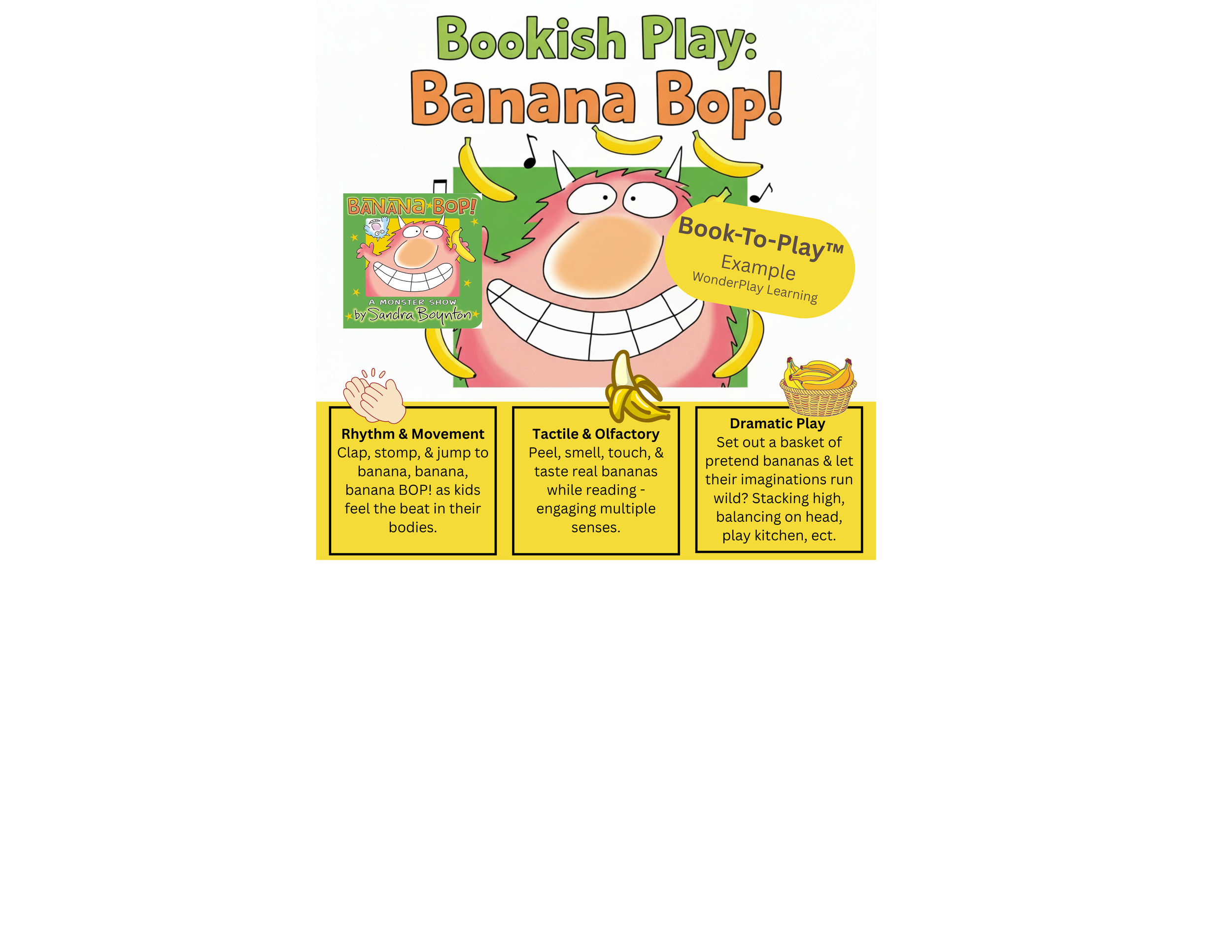
Here’s one snapshot of Book-To-Play™ at work:
A familiar picture book becomes the story spark.
Simple materials echo the book’s theme.
The child moves, pretends, explores, and returns to the story in their own way.
There’s no checklist. No expected outcome. Just a loop of story, sensory play, and conversation.
Book-To-Play™ works with any book because it follows the child, not the plan.
What the Grown-Up Actually Does
You don’t have to “teach” Book-To-Play™ for it to work.
Your role is simple:
Notice what your child is doing
Name what you see without judgment
Nudge gently, only if it fits
Watching counts. Repeating counts. Pausing counts.
Short, warm interactions matter more than long, perfect lessons. Children borrow our calm. When you slow down and follow their lead, curiosity has room to grow.
Bringing Book-To-Play™ Into Your Days
You don’t need elaborate setups or themed bins. A favorite book, a few safe materials, and time to explore are enough.
Book-To-Play™ sensory kits are designed to make this approach easy to step into by pairing thoughtfully chosen books with simple materials that invite hands-on, story-based play.
Explore Book-To-Play™ sensory kits and see how stories come to life through play.
Where to Go Next
If you’re ready to dive deeper:
Download the FREE Book-To-Play™ Starter Guide HERE
Save a pin and try one small moment this week
Book-To-Play™ isn’t about doing more.
It’s about noticing what’s already happening and letting stories and senses do the work.
What Is Book-To-Play™? Sensory-Rich, Book-Based Play for Early Literacy
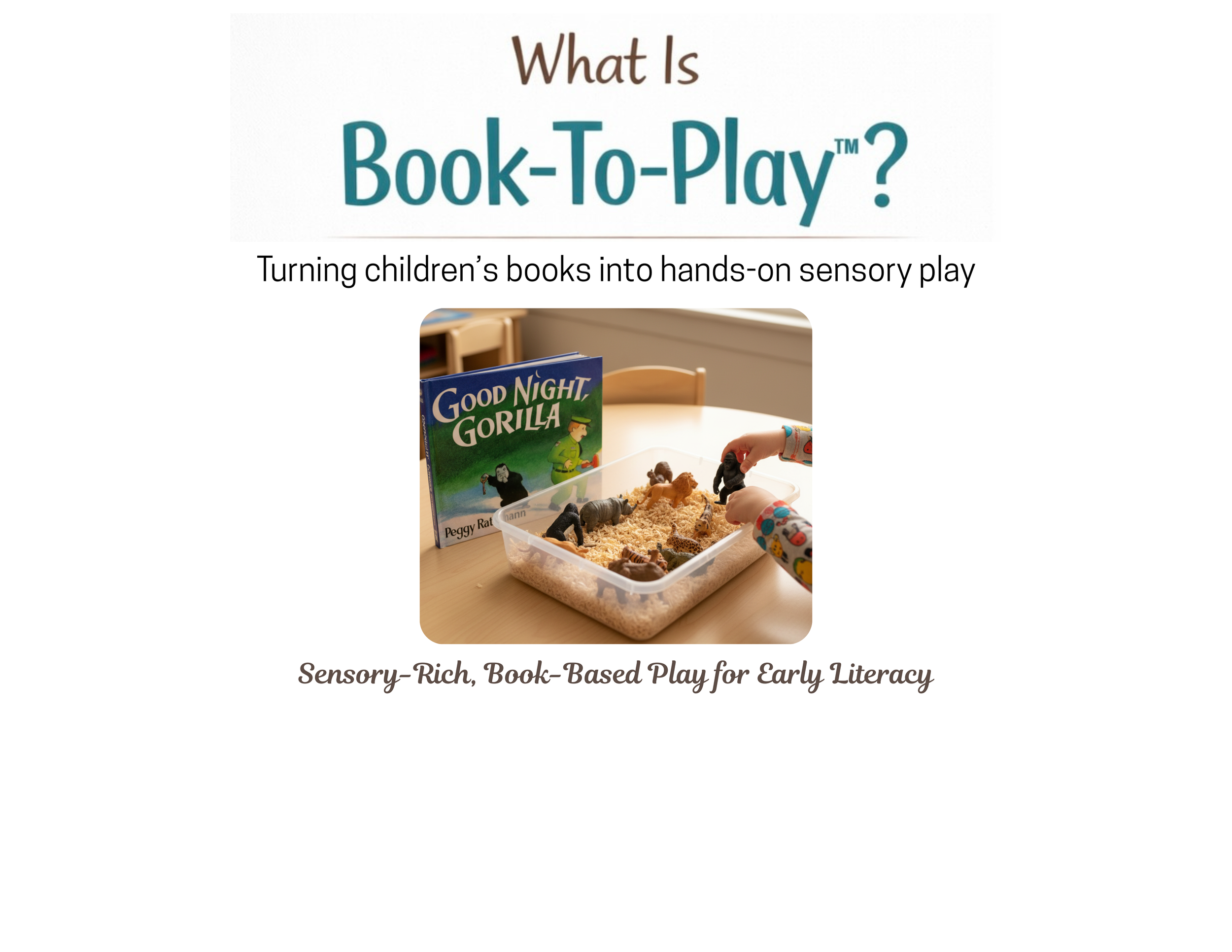
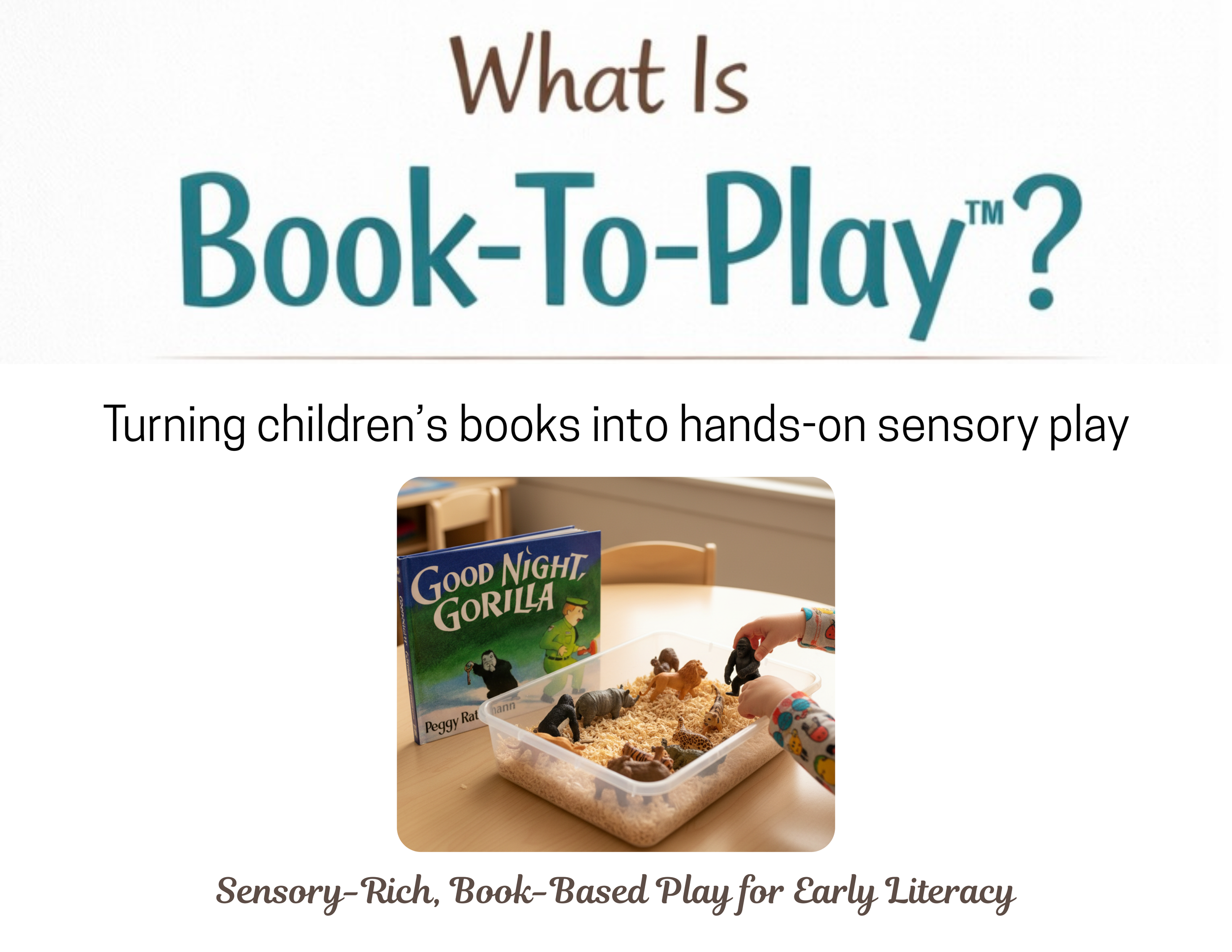
Book-To-Play™ is a sensory-rich, play-based approach that turns children’s books into hands-on play invitations, supporting early literacy, language, and regulation through everyday moments of play.
What Is Book-To-Play™?
Book-To-Play™ is a sensory-rich, play-based learning approach that brings children’s books to life through hands-on exploration. Instead of learning stopping when the book closes, Book-To-Play™ invites children to interact with books—both stories and informational texts—through movement, touch, investigation, and conversation.
Designed for young children, Book-To-Play™ supports early literacy, language development, and curiosity by treating books as living sources of ideas, questions, and discovery, not just stories to listen to.
How Book-To-Play™ Works
Book-To-Play™ follows a simple, flexible cycle that can begin at any moment in your day:
Story Spark
A book, picture, remembered line, or familiar story moment.Sensory Invitation
A simple setup inspired by the story’s colors, sounds, or setting.Playful Exploration
Scooping, splashing, building, moving, pretending.Language & Reflection
Talking, singing, retelling, or noticing together.
These parts can happen in any order. Some days you start with a book. Other days you start with play and return to the story later. The learning deepens because the cycle keeps looping, not because it follows a perfect routine.
Book-To-Play™ Works With All Kinds of Books
Book-To-Play™ isn’t limited to storybooks or fictional narratives.
While stories naturally invite imagination and dramatic play, informational and concept books invite a different kind of exploration—observing, sorting, testing, comparing, and wondering.
A book about animals might lead to sensory bins and movement.
A book about weather might spark water play or wind experiments.
A book about colors, shapes, or tools might invite matching, building, or investigation.
In Book-To-Play™, the book—whether narrative or informational—becomes the spark for hands-on learning.
Why Book-Based Sensory Play Matters
Sensory play isn’t a trend. It’s a brain need.
When children squish, pour, dig, climb, and move, they are building the brain pathways that support attention, language, problem-solving, and emotional regulation. When sensory play is paired with books, children connect words, ideas, and experiences across multiple senses, strengthening comprehension and early literacy in ways that feel natural and joyful.
Book-To-Play™ vs. Crafts or Worksheets
Book-To-Play™ focuses on process over product.
There is:
No expected outcome
No model to copy
No pressure to perform
Instead, children are invited to explore stories in their own way, building confidence, curiosity, and a love of learning through play.
Who Book-To-Play™ Is For
Book-To-Play™ is designed for:
Toddlers and preschoolers
Families looking for meaningful, screen-free play
Homeschool families
Early learning classrooms and childcare settings
Because the play invitations are open-ended, they naturally adapt to different ages, abilities, and sensory needs.
Bringing Book-To-Play™ Into Your Home or Classroom
You don’t need elaborate setups or themed bins to begin. A favorite book, a few safe materials, and time to explore are enough.
Book-To-Play™ sensory kits make this approach easy to step into by pairing thoughtfully chosen children’s books with simple materials that invite hands-on, story-based play.
Explore Book-To-Play™ and turn storytime into playtime.